
Dubai desert safari blog
Dubai Desert Safari Guide: How to Plan the Right Trip
Use this clear Dubai desert safari guide to compare timing, comfort, transport, activities, prices and booking details before choosing your trip.
Use this article to understand the main safari formats. For a step-by-step booking checklist, visit our Dubai safari planning guide, or compare current tours and prices.
Planning a Dubai desert safari starts with choosing an experience that fits your group. Dubai has morning, evening, private, family, adventure and gentler safari formats. The right one depends on your group, the time you have and how much motion you enjoy.
Quick answer
Compare the safari format, pace, transport and total price for your own group before choosing. Separate essential arrangements from optional upgrades, then check the written itinerary and booking terms. A submitted request is followed by the team's availability and price confirmation.
The official Visit Dubai safari guide says morning and evening tours are available through the year. Morning trips suit people who want early light and a shorter plan. Evening trips are popular with guests who want sunset, a camp visit or dinner, but every operator builds packages differently. Always check the written details.
Choose the time of day first
Start with your holiday schedule. A morning safari can leave the rest of the day free. An evening safari may take up most of the afternoon and evening, depending on pickup and the confirmed program. There is no single timetable for every company.
If you want a classic later-day trip, read the Evening Desert Safari Dubai details. If you are still comparing all formats, open the Dubai safari tour collection.
Dubai uses Gulf Standard Time, which is UTC+4 throughout the year. This matters when you book from another country or arrange airport-day plans. The UAE Government fact sheet (opens in a new tab) confirms the time zone and the country’s desert climate.
Decide how much motion feels right
Dune bashing involves climbs, drops and turns in a 4x4. Many guests enjoy it, but it is not the only way to see the desert. A calmer itinerary can focus on scenery, a camp, a meal or other confirmed activities.
If a guest has a back or neck concern, recent surgery, pregnancy, strong motion sensitivity or another health issue, do not guess. Ask a qualified medical professional for personal advice and tell the booking team before the trip. You can also compare a desert safari without dune bashing.
Check transport in plain language
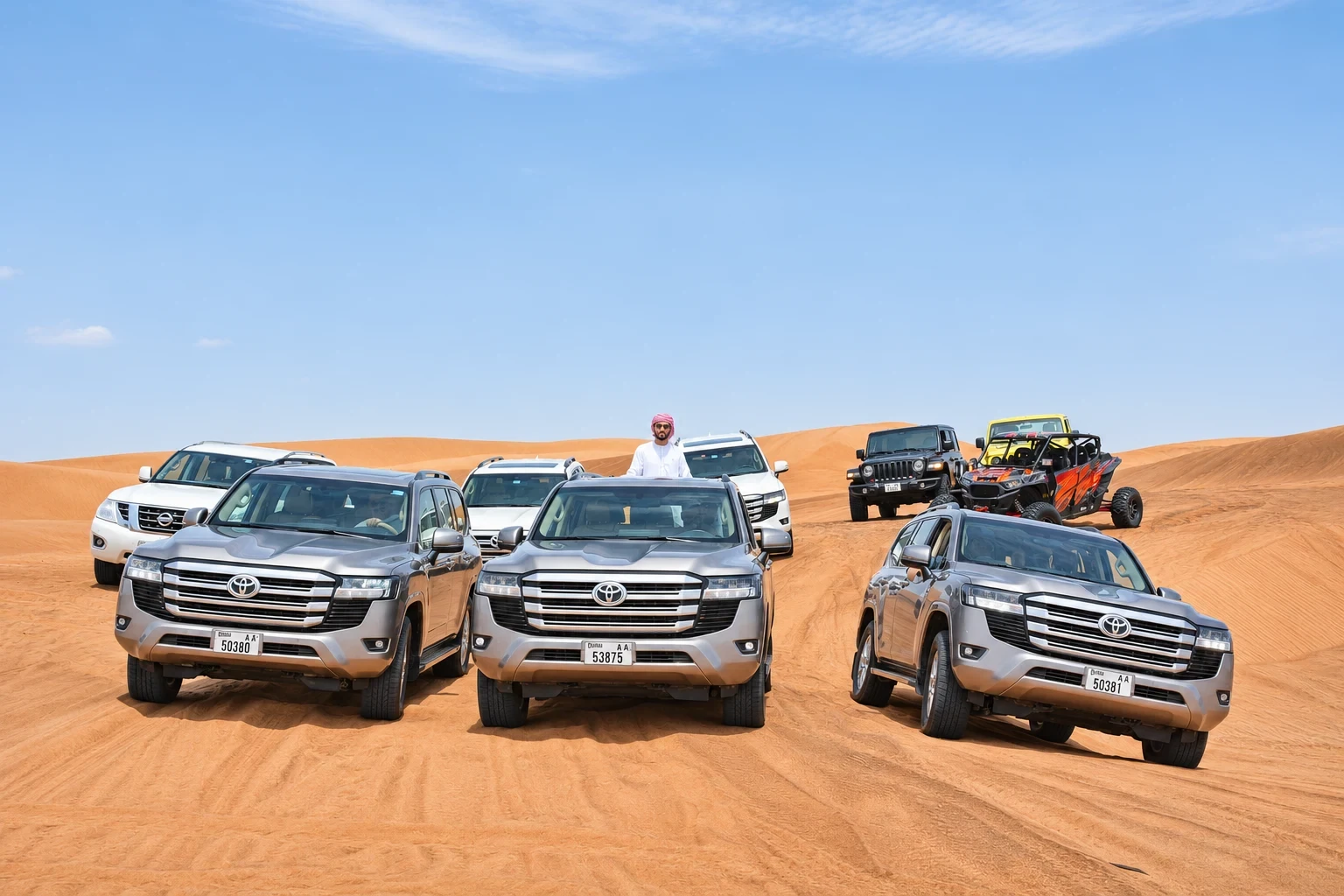
Ask whether your package includes hotel pickup or a desert meeting point. Our premium self-drive experience includes a driving car and a backup car; the team confirms the location and driver eligibility before payment.
Visit Dubai advises travellers to use a reputable safari company and not try unplanned sand driving without the correct skill and vehicle. Dubai’s RTA also has a specific safari-driving permit service for commercial drivers. That is a good reason to use an organised trip rather than treating the desert like a normal road.
Review the Dubai pickup areas guide before choosing a package. Wait for the exact location and pickup time instead of relying on an estimate from a different company.
Compare inclusions and the final price
Two tours with similar names can have different contents. One price may include transfers, while another may use a meeting point. Dinner, quad biking, buggy time, camel encounters, sandboarding and camp seating may be included, optional or unavailable on a given date.
Write down five things before you confirm:
- Date and number of guests
- Adult, child and infant ages
- Pickup or meeting arrangement
- Included activities and their duration
- Final total in AED and the cancellation terms
Starting prices are useful for comparing options, but the written confirmation should control your booking. On this site you can start the booking form, receive a reference and then follow the confirmed pickup instructions.
Pack for sun, sand and cooler evenings
Wear comfortable clothes that can get sandy. Trainers or strapped sandals are usually easier than loose flip-flops. Add sun protection and water. During the cooler outdoor season, an evening in the desert may feel much cooler after sunset, so a light layer can help.
The official Visit Dubai desert safari page (opens in a new tab) also recommends comfortable clothing and notes that winter evenings can need warmer clothes.
Final booking check
Read the confirmation once more before travel. Check the contact number, date, pickup method, guest count and special requests. Keep the reference on your phone. If something is missing, ask before the driver arrives.
A good Dubai desert safari is not about doing every activity. It is about choosing a clear plan that fits your group and arriving prepared.
A practical decision map for your first Dubai safari
Begin with the experience you want to remember. Some visitors picture a vehicle adventure, some want an evening with their family, and some want time in the landscape without dune bashing. These are different priorities. Write down the main reason for your outing before opening several product pages. It helps you recognise whether an advertised inclusion contributes to that aim or is simply another line in a long package list.
Next, separate essentials from preferences. A confirmed return arrangement may be essential because you have another commitment. A particular photograph may be a preference. Your family staying together may be essential, while a seating upgrade may be optional. Use those distinctions to narrow the shortlist. Do not start by choosing the cheapest or most expensive name and trying to make the whole day fit around it afterwards.
A short list of two or three relevant products is usually easier to compare than twenty unrelated experiences. Include your group size and date in every enquiry. You will then be comparing actual proposals for the same people rather than matching a photograph from one page against a headline price from another.
Pick the product category before the package label
A safari, a standalone vehicle activity and an attraction ticket are different categories. An ATV booking can focus on a supplied bike allocation. An evening safari may involve a wider programme. A city tour concerns a different route altogether. The presence of all three on one website does not combine them into one reservation or make their transport arrangements identical.
The safari collection is the starting point for desert products. Read the description and charging unit on each page. If a product is sold per bike or per buggy, do not interpret that amount as a complete per-person evening outing. If it is a tailored request, do not treat the absence of an immediate total as a free service.
Package labels such as premium and VIP can help you find a shortlist, but they do not replace the inclusion list. Ask what specifically changes between the offers you are comparing. The useful distinction might concern a vehicle, camp arrangement or other service; it must come from the actual proposal rather than your interpretation of the name.
Decide which time commitment fits the whole holiday
Your available time begins before the activity and ends after your return. Consider the journey from your accommodation, the agreed arrival arrangement, the programme itself and the journey afterwards. A listed activity duration is not necessarily the length of time you should leave free in your diary. This matters particularly when an experience starts at a meeting point that you reach independently.
Use a morning outing if its confirmed timing matches the rest of your day, rather than assuming every morning product ends before a particular lunch reservation. Use an evening outing if you can leave enough space around its confirmed programme. An overnight request needs a separate discussion about sleeping arrangements and the following morning, not simply a later return from an evening product.
Tell the team about a fixed commitment before booking. They can explain whether the proposed arrangement is practical. Avoid asking for a schedule that depends on every journey and activity taking the shortest imaginable time. A good holiday plan leaves room for the actual confirmed sequence instead of relying on an optimistic label.
Distinguish group privacy from private facilities
A private vehicle can keep your travel group together, but it does not automatically create an exclusive camp or dining area. Reserved seating can be useful without being private dining. A tailored itinerary can address a request without making every stop exclusive. Discuss these as separate features if privacy is a reason for your booking.
For a couple, identify whether the priority is a private journey, time for photographs or a particular table arrangement. For a family, it might be travelling together rather than avoiding every shared space. For friends, the aim may be to coordinate different activity preferences. Use plain descriptions of those needs when comparing proposals.
A useful test is to ask which parts of the outing would still be shared with other guests. The answer can be more informative than a broad promise of luxury. You can then decide whether the proposed private element is worth the price difference for your group. Do not pay for a label without understanding the arrangement it represents.
Compare the guest count with the price unit
Count all adults, children and infants in the travel party. Then identify which charging unit applies to each part of the booking. Some products use a per-person rate, while standalone activities can use a per-vehicle rate. Transport can add another unit. Keeping these separate avoids comparing totals that cover different quantities.
The evening page currently offers shared places and a private-vehicle option. Standalone ATV and Polaris products describe bike or buggy allocations. The premium self-drive experience uses a per-paying-guest rate with a minimum group. These examples show why one advertised amount cannot be used as a universal Dubai safari price.
Do not leave an infant out because the price is not immediately calculated. Seating, eligibility and any charge still need confirmation. Similarly, a child fare does not establish eligibility for a powered activity. Give accurate ages and ask for the accepted arrangement. The complete offer should make clear which people and services the final amount covers.
Keep vehicle activities separate in the comparison
If quad biking or a buggy session is the main reason for your visit, investigate that activity first. Ask about the actual riding duration, supplied vehicle, permitted participants and location. The total duration of a safari cannot be used as the promised driving time of a vehicle activity within it.
Then ask how the activity fits into the wider plan. Is it part of the selected safari offer or a standalone reservation? Does everyone participate, or is a waiting arrangement needed? Are transport and return included or selected separately? These questions establish the structure before you compare prices.
You do not need to choose every extra shown on a page. Select activities that suit the participating people and the time available. A shorter confirmed list is easier to enjoy than an ambitious collection of assumptions. If an activity is essential, have it identified in the written booking rather than relying on a photograph that shows it somewhere on the website.
Assess camp and meal arrangements as their own part of the day
If a camp visit is important, ask what the selected package actually includes there. Seating, food service, meal choices and entertainment are distinct items. A general camp photograph cannot establish the menu or table allocation for your date. Ask the team to explain the services that matter to your group.
Consider practical preferences as well as appearance. Someone may value a regular chair more than a stage view. A larger family may need nearby tables rather than a particular decorative setting. If meal timing or a food requirement affects your plans, raise it before booking and ask what the relevant venue can confirm.
Keep optional upgrades beside the service they change. This helps you see whether paying more improves something your party will use. A private vehicle rate should not be read as a complete camp specification, and a seating upgrade should not be assumed to change transport. Clear comparisons separate those elements before bringing them together into a final plan.
Plan pickup with a complete address
Provide the actual hotel or building name and area, not only the name of the neighbourhood. A similarly named property elsewhere can lead to confusion. If the location changes after your initial enquiry, tell the team and confirm whether the collection arrangement needs to change too.
Ask whether the accepted pickup is at your named location or another agreed meeting point. Transport included does not mean every possible address is automatically covered. Keep the final collection instruction with the booking reference and make sure the lead contact can be reached on the travel day.
Do not send unnecessary room numbers or personal documents in a general planning message. Share the information the booking team needs through the established contact. The goal is a clear collection arrangement for the actual group, not a long message containing private details that do not help identify where you should meet.
Make a meeting-point plan before selecting self-arrival
Independent arrival can suit some travellers, but it requires its own logistics. Obtain the precise meeting point, access instructions and return arrangement before setting out. A vague desert district or an old map pin is not a substitute for the current instruction associated with your experience.
Clarify what happens after you arrive. You may be joining an organised driver-led activity, or you may be participating in a supplied-vehicle driving experience. Those are different formats. The phrase self drive does not establish which one is being offered, and a normal road vehicle should not be assumed suitable for an unconfirmed access route.
Plan the journey back as carefully as the outward trip. Ask where the activity finishes and how you return to your arrival point. If you use a taxi or hired driver, agree a practical collection arrangement. Do not depend on an unbooked transfer becoming available simply because you have finished a paid activity.
Use one clear plan for a mixed group
For friends or several households, collect preferences before asking for a quotation. Identify who wants each activity and who may choose to wait. Keep the full passenger count alongside those participation choices. An optional activity selected by two people should not cause the rest of the group to disappear from the transport discussion.
Choose one organiser to keep the latest accepted plan. That person can consolidate date, guest count, pickup, activity choices and unresolved questions. Other adults should still receive the practical meeting instructions so the group does not depend on one phone being available at every moment.
Agree how shared and individual costs will be divided before collecting money. The operator's charging units and your group's bill-sharing method are separate matters. An equal split among friends does not change the booking's vehicle allocation, participant rules or cancellation conditions. Keep those decisions clear enough that everyone knows what they have agreed to.
Review the confirmation rather than only the payment amount
Before accepting, compare the written proposal against your original essentials. Check the named product, date, guest details, transport, activities and whole-group total. Resolve unanswered questions that could change your decision. A payment amount alone cannot tell you whether the arrangement matches what your family or friends expect.
Keep change and cancellation conditions with the current version of the plan. If someone joins, withdraws or changes their intended activity, ask whether the quotation needs updating. Do not assume that a revised guest count automatically adjusts every vehicle, meal or seating allocation.
After confirmation, share the useful instructions with the travelling adults. Save the booking reference and contact number so they are easy to find. Avoid mixing the accepted plan with older adverts or abandoned options. The last planning step should leave your group with one understandable outing, not several competing versions of what might happen.
Choose the next page by the question you still need answered
Use the product pages to establish the actual offer and the planning articles to work through your choices. For cost comparisons, read the prices guide. For vehicle-format ambiguity, read the self-drive explanation. For a group that wants different activities, use the friends planning guide.
If your remaining question concerns a current operational fact, ask the team rather than trying to infer it from a general guide. That includes the duration of an unspecified package, exact camp services, riding minutes and a particular pickup address. A helpful article explains what to compare; the accepted booking establishes what your selected departure provides.
You can then make a deliberate choice. Select the format that fits your time and group, confirm the details that affect participation and cost, and keep the final arrangement together. The purpose of planning is to make the day easier to enjoy, not to turn every possible desert activity into a requirement for one visit.
Distinguish a page description from an accepted departure
A product page explains the published offer and helps you decide what to request. Your booking confirmation applies that discussion to a particular date, group and arrangement. Keep both roles clear: a useful general description does not make every optional feature a confirmed inclusion, while a tailored quote should not leave the essentials hidden behind a package name.
For example, if you ask for a family outing with private transport and particular camp seating, check each of those features in the reply. Do not assume that accepting one request automatically accepts the other. This simple separation makes the final proposal easier to understand and gives the team a precise question if a material detail still needs an answer.
Frequently asked questions
How long does a Dubai desert safari take?
There is no universal duration. Some experiences are short activity sessions, while evening and overnight plans take longer. Use the duration and pickup details in your own confirmation.
Is morning or evening better?
Morning is useful for early light and a freer afternoon. Evening suits guests who want sunset or later activities. The better choice depends on your schedule and the exact package.
Can I avoid dune bashing?
Yes. Request a no-dune-bashing itinerary and make sure that wording appears in your written confirmation.
Does self drive mean driving on dunes?
Our premium self-drive experience includes a driving car and a backup car. Confirm the route, driving eligibility and instructions with our team before booking.
When should I book?
Book when your date and guest count are firm. Popular dates can fill sooner, but availability changes, so check the live booking details rather than relying on a fixed rule.
Related tours and planning guides
Add a separate Dubai attraction visit
For a wider Dubai itinerary, compare these attraction options separately. Check the selected ticket, admission conditions and availability before booking.
- Burj Khalifa observation deck experience
- Dubai Aquarium and Underwater Zoo visit
- Dubai Frame skyline and heritage visit
Planning a morning trip
Read our morning desert safari pickup and duration guide for the listed activities, approximate timing, meal exclusions and details to confirm before booking.